Crossing to the South Pacific, Part 2
Ding, ding......ding, ding......ding, ding.....ding. It's morning and the ships clock has just rang 7:30 am, which means it's time for me to go to bed (and wake Brett). But before I can find the sweet release of sleep, there is work to be done.
It's been a particularly terrible night - one of the worst we've had out here. The seas were highly confused and there were very light winds, so we were motoring. Motoring in confused seas means you are like a cork bobbing in the ocean because there is no sail area to provide drive through the waves. I imagine it's fairly similar to being in a giant washing machine. Since we were in the heart of the ITCZ, we also experienced several squalls, where the wind speed would go from nothing to 20 knots in about 5 minutes with heavy rains drenching everything in the cockpit (as it was raining sideways), all of which would last about 25 minutes and then we would be back to nothing again.
With this crazy bobbing cork action it's pretty impossible to sleep, so we were both exhausted when the clock signalled the watch change. Around 6am the winds had filled in and become steady again, and while I was delighted that the wind had returned, I just wanted to sit down and cry. I can't describe how tired and defeated you are after that kind of night - just completely wrung out. And even something small like putting up the sails, which has long since become routine, seems absolutely overwhelming.
But we got through it, and then I went to bed. And lo and behold - I slept! The deep sleep you can only achieve when the boat is well balanced and the seas are mild, and you are completely done in. Three blissful hours of sleep. When I woke the sun was bright in the sky, the cockpit was dry and my husband was smiling at me. It was a new day - and a great one at that. We had mild seas (long swells all from the same direction) and the wind was absolutely PERFECT! Not too strong, not too light.....just right. At the end of the day, after running our genniker for most of the day, we made the right decision and brought it down right before the winds kicked up. It was like magic - the perfect day.
The dichotomy of emotions you go through out here is truly incredible. Change is constant - nothing stays perfect (or terrible) for long, so you are in a constant state of flux. While one night can be so bad you think you'll never get through it, the next can be one of the best you've had. There is no dependable reality - you just have to take what Mother Nature has decided to dole out at any given moment.
Not being able to control my environment has made this trip one of the hardest things I have ever done. Because we are stuck. There is no getting off this ride. We are thousands of miles from anything and quitting is not an option. So you get through the tough times. Because you have to. You find that little bit of strength that you didn't know you had left and you put it to use. Then you get some sleep and pray for a better day tomorrow - and sometimes you get it. And when you wake up and the sun is shining and the waves are nice and the wind is perfect, you are glad to be here in this moment.
----------
radio email processed by SailMail
for information see: http://www.sailmail.com

Friday, April 12, 2013

Sunday, April 7, 2013
The Crossing to the South Pacific, Part 1
Crossing to the South Pacific, Part 1
Tonight, Brett and I decided we were crazy. It was about 3am and we were in between watch schedules, having just completely pulled in the headsail and de-powered the main. The winds were up in the low 20's and the seas were getting pretty big. With just a reefed mainsail, we were still doing 7.8 knots over ground, so it's a rock'n night. We are sitting in the cockpit trying to cool off, talking about how crazy the last couple of nights have been (lots of late night sail changes). I looked at Brett and said, "You know what? WE are crazy!" (i.e. crazy to be sailing our boat almost 3000 miles across absolute nothingness instead of staying safely put at home). He said, "You're right, we could be home sleeping in our comfy bed, after a night of watching TV and/or drinking too much wine with our friends." There was a pause and then we looked at each other and laughed - thinking the same thing. We might be crazy, but it's good crazy! We were up in the middle of the night - looking at more stars than you can possibly imagine, sailing like a bat out of hell in the middle of nowhere! If that's not living life to it's fullest I'm not sure what is.
The trip thus far has not been easy. We've had maybe two days (out of 8) that I would term "fairly comfortable", but most days the boat is being tossed about in some pretty confused waves. I keep thinking, how can the waves be so confused when there is nothing around us for a 1000 miles, but there it is. Those long period waves we'd dreamed about - still a pretty rare thing. But it's amazing what you can get used to out here. Needing to hold on to something for EVERY step you take 24/7 is a constant reality. And I've never been so glad to have cooked the majority of our dinners prior to our departure as there is NO WAY I could be cooking in these seas.
As of right this minute, we've traveled 1143 nautical miles with really variable wind speeds. Some days it blows just 7-12 knots and we'll run the gennaker all day (those are the good days). Other nights (like tonight) it blows 19-24 with big waves, and we run with a reefed main and nothing else. I've come to learn that one thing you can definitely depend on is that the wind will kick up at night - usually sometime between 10pm to 2am. Which means that a lot of our sail changes have been taking place in the middle of the night...in the dark. I'll admit it's been scary at times, but I'm getting used to it and the two of us are becoming a very well oiled machine, making the changes as if we'd been doing it for a lifetime.
It's hard right now to imagine that I'm only 1/3 of the way through this "experience of a lifetime" - this crossing of the South Pacific. That we likely have two more WEEKS of this to "look forward to". To say I will be happy to get to the other side is the understatement of a lifetime. But at the same time I am trying hard to take this experience in and live each moment of it. This is not something that very many people do, with an average of just 150 boats making the journey each year. We are a very small group. So I want to remember this journey, the good along with the bad.
This morning (one of the bad moments), I had to just yell really loudly about how much that moment sucked (another sail change and feeling exhausted from the lack of sleep). It was amazing how much better it made me feel to do a little yelling. Later (after some sleep), Brett and I were laughing over it and joking around with each other. Happy. That's the good stuff - simple, but GOOD. I guess you can't really have one without the other to help you recognize when it's good.
Here's to hoping there will be more good than bad over the next two weeks!
----------
radio email processed by SailMail
for information see: http://www.sailmail.com
Tonight, Brett and I decided we were crazy. It was about 3am and we were in between watch schedules, having just completely pulled in the headsail and de-powered the main. The winds were up in the low 20's and the seas were getting pretty big. With just a reefed mainsail, we were still doing 7.8 knots over ground, so it's a rock'n night. We are sitting in the cockpit trying to cool off, talking about how crazy the last couple of nights have been (lots of late night sail changes). I looked at Brett and said, "You know what? WE are crazy!" (i.e. crazy to be sailing our boat almost 3000 miles across absolute nothingness instead of staying safely put at home). He said, "You're right, we could be home sleeping in our comfy bed, after a night of watching TV and/or drinking too much wine with our friends." There was a pause and then we looked at each other and laughed - thinking the same thing. We might be crazy, but it's good crazy! We were up in the middle of the night - looking at more stars than you can possibly imagine, sailing like a bat out of hell in the middle of nowhere! If that's not living life to it's fullest I'm not sure what is.
The trip thus far has not been easy. We've had maybe two days (out of 8) that I would term "fairly comfortable", but most days the boat is being tossed about in some pretty confused waves. I keep thinking, how can the waves be so confused when there is nothing around us for a 1000 miles, but there it is. Those long period waves we'd dreamed about - still a pretty rare thing. But it's amazing what you can get used to out here. Needing to hold on to something for EVERY step you take 24/7 is a constant reality. And I've never been so glad to have cooked the majority of our dinners prior to our departure as there is NO WAY I could be cooking in these seas.
As of right this minute, we've traveled 1143 nautical miles with really variable wind speeds. Some days it blows just 7-12 knots and we'll run the gennaker all day (those are the good days). Other nights (like tonight) it blows 19-24 with big waves, and we run with a reefed main and nothing else. I've come to learn that one thing you can definitely depend on is that the wind will kick up at night - usually sometime between 10pm to 2am. Which means that a lot of our sail changes have been taking place in the middle of the night...in the dark. I'll admit it's been scary at times, but I'm getting used to it and the two of us are becoming a very well oiled machine, making the changes as if we'd been doing it for a lifetime.
It's hard right now to imagine that I'm only 1/3 of the way through this "experience of a lifetime" - this crossing of the South Pacific. That we likely have two more WEEKS of this to "look forward to". To say I will be happy to get to the other side is the understatement of a lifetime. But at the same time I am trying hard to take this experience in and live each moment of it. This is not something that very many people do, with an average of just 150 boats making the journey each year. We are a very small group. So I want to remember this journey, the good along with the bad.
This morning (one of the bad moments), I had to just yell really loudly about how much that moment sucked (another sail change and feeling exhausted from the lack of sleep). It was amazing how much better it made me feel to do a little yelling. Later (after some sleep), Brett and I were laughing over it and joking around with each other. Happy. That's the good stuff - simple, but GOOD. I guess you can't really have one without the other to help you recognize when it's good.
Here's to hoping there will be more good than bad over the next two weeks!
----------
radio email processed by SailMail
for information see: http://www.sailmail.com
Friday, March 29, 2013
Departure Prep
 |
| Pat & Janet come down from Seattle! |
 |
| Fishbowl Margaritas! |
But back to that list – for those of you that care, here are
some of the things we’ve accomplished in the last few weeks….
- Service
the water maker and rebuild the housing (thanks for the help Les!)
- Re-caulked
our windows (small leaks)
- Re-caulked
the V-berth hatch – big leak!
- Install
switch for solar panels so we can turn them off when transmitting on the
SSB (lowering radio interference)
- Set up
getting weather information via our sat phone
- Change
the oil on both outboards, genset and main engine
- “Winterize”
and stow the outboards
- Defrost
the fridge and freezer
- Cook
meals for at least ½ the passage
- Package
up our winter cloths for storage
- Organize
and catalog all charts and spare parts
- Service
and install new line on our furler
- Fix
our engine driven refrigeration (AGAIN)
- Change
out all fuel filters
- Install
a priming pump for the main engine
- Swapp out the fuel filtering system for the main genset
Frankly there was a LOT more than that, but that should give
you a good idea of the types of stuff one does before a huge trip like
this.
 |
| Thankfully no one was hurt... |
 |
| Provisioning gone wild! |
 |
| Holding our official Zarpa - time to leave! |
So! Now it’s time to make this huge journey of just over 2800 miles going approximately 6 miles per hour. We are hoping it will take around 21 days to get there. For me, it’s been a roller coaster of emotions these past few weeks. Fear of the unknown and of being at sea for such a long time. Excitement at the thought of doing something so BIG and getting to enjoy one of the most beautiful spots in the entire world from the comfort of my own home. Sadness that I’ll soon be REALLY far away from all my family and friends (who are currently just a short plane ride away), but also looking forward to seeing all the new friends we’ve met that are also making the crossing. But feeling all of these things is what lets me know I am alive and living my life to the fullest in this moment – so I welcome the good AND the bad days…..but I sure do prefer the good ones!
Here’s hoping for fair winds and following seas!
Thursday, March 14, 2013
Mainland Mexico
Ever since we came across to the mainland we have been continually delighted with the small towns we have visited. I cannot express how nice it has been to get to know the “real” Mexico compared to the touristy towns I have been to in the past. Traveling by boat allows us to get to many areas that would have been a little more challenging to see by car. While many of these places are still clearly dependent on tourist dollars – they are so far removed from what you see in Cabo, Mazatlan or Puerto Vallarta that you might think yourself in a different country all together. Following are some thoughts on some of the places we have visited on the mainland over the past month…
Bucerias
We went here with our friends Les and Diane on Gemini – who have been cruising for over 10 years now in Mexico and South America. They introduced us to Abalito, the coolest little seed and spice store I’ve ever seen. This place had rows and rows and rows of every spice, seed or grain you could ever want – all sold by the kilo (or gram). It was a little slice of heaven! Bucerias is an easy bus ride from La Paz or Puerto Vallarta and shouldn’t be missed.
 |
| Enjoying Mojitos in Barra Navidad |
Ever since we came across to the mainland we have been continually delighted with the small towns we have visited. I cannot express how nice it has been to get to know the “real” Mexico compared to the touristy towns I have been to in the past. Traveling by boat allows us to get to many areas that would have been a little more challenging to see by car. While many of these places are still clearly dependent on tourist dollars – they are so far removed from what you see in Cabo, Mazatlan or Puerto Vallarta that you might think yourself in a different country all together. Following are some thoughts on some of the places we have visited on the mainland over the past month…
 |
| Fishing Pangas in La Cruz |
La Cruz
La Cruz is located in Banderas Bay, about a 45 minute drive
northwest of Puerto Vallarta. It’s a
very popular destination for cruisers as it has a large anchorage, a very nice
marina, good access to boat parts, an excellent fresh fish market and a
wonderful little town where you can get most things you need with a little
searching.
What I think makes La Cruz so
fantastic is the cornucopia of restaurants that you can find, offering a large
variety of dishes. Along with great
food, many of them also showcase live music!
One of our favorite stops was a restaurant called Tacos on the Street. While the name brings to mind a cart on the
road, it’s actually a real restaurant.
They have just three items on the menu – beef tacos, beef quesadillas,
or beef tostadas – and while they like to keep it simple, any one of those
options is delicious and CHEAP! A taco
“con todo” (“with everything”, which is the ONLY way to order it) is just 20
pesos (about $1.75 US). How great is
that?
 |
| La Cruz Sunday Market |
The music you can see in La Cruz is diverse and interesting. Imagine yourself walking through an arched doorway
into an open courtyard with tile floors.
Near the center is a small raised stage, with a semi- open kitchen at
the back, where you can watch the meals being prepared. You sit down at a classic Mexican table (a
plastic table covered with some sort of colorful cloth) and in front of you sits
a lone man on an old wooden chair, under a huge tree, holding what is clearly a
well-loved guitar. The night is warm
with a light breeze and the music this man produces is incredible. His name is Lobo and he’s an amazing flamenco
guitarist that has been a regular in the area for many years. Watching his fingers race along the neck of
his guitar while his right hand strummed and patted and shook over the guitar
strings was an experience that I will likely never forget. It’s times like this that remind us of why we
are on this trip.
 |
| House in Melaque |
Barra Navidad & Melaque
About a 140 miles south down the coast is a wonderful town
called Barra Navidad. The town is set
along the beach with a large lagoon running along the backside. There is a HUGE resort located here that is
absolutely beautiful – with water taxis running between it, the lagoon and
town.
 |
| Hotel in Barra Navidad |
On our first morning here we heard
a light knock on our hull. We emerged to
find a classic Mexican panga (small boat) that had been converted to a
traveling bakery with a French pastry chef!
Yes, he’s an enterprising local imported from France that actually
brings the goodies to you! We were
delighted to purchase some of his wonderful little quiches, croissants and baguettes
and I could see him becoming a VERY bad habit if you were to stay for any
length of time.
 |
| On the Streets of Barra Navidad |
The town of Barra is filled with great restaurants and
stores where you can find any kind of knickknack along with some very good
artwork. There is a beautiful white sand
beach that runs the length of the town and connects it to the next town to the north
called Melaque. We walked the beach
(about 2.5 miles one way) to visit Melaque and it was well worth the trip –
lots of great places to wonder through and the people in both towns were
incredibly friendly and helpful. While
there, we found this amazing little store where one family has been weaving
rugs for many generations. Grandpa
raises the sheep, grandma takes the wool and hand dies it using traditional
methods and the “kids” (now WELL into being adults) do the weaving. The result is pure, vivid colors made from
all natural products – beautiful! We had
been searching for our “Mexico keepsake” and we couldn’t imagine a better spot
to get it.
 |
| Mexican "Keepsake" Hand Woven Rug |
 |
| Artist in Bucerias |
This town is just a few miles southeast of La Cruz and is
kind of an eclectic mix of old town Mexico and a modern day city – battling it
out block by block. You can get almost
anything you need here, along with lots of stuff you didn’t even know you wanted! There are all the normal tourist items and
shops, along with some less expected items.
 |
| Les & Diane in Bucerias |
We went here with our friends Les and Diane on Gemini – who have been cruising for over 10 years now in Mexico and South America. They introduced us to Abalito, the coolest little seed and spice store I’ve ever seen. This place had rows and rows and rows of every spice, seed or grain you could ever want – all sold by the kilo (or gram). It was a little slice of heaven! Bucerias is an easy bus ride from La Paz or Puerto Vallarta and shouldn’t be missed.
 |
| Lunch Stop in Bucerias |
These are just a couple of our favorite spots and I wish
that we had planned more time here in Mexico as it has FAR exceeded our
expectations. The people are amazing –
warm, friendly and inviting – willing to lend a helping hand in any way they
can. The beaches are beautiful, the air
is warm and the food is incredible. I am
VERY happy to report that neither Brett nor I have experienced any issues with
“Montezuma’s Revenge” – not even at the many spots that most would consider
pretty dicey.
 |
| Mexican Scaffolding |
Mexico is a wonderful place to visit. I know a lot of people are concerned with
visiting here due to the drug war, but I can honestly say we have personally
seen zero violence and have felt extremely safe everywhere we have been. If you make the effort to get a little off
the beaten track and avoid the larger cities on the boarder and inland, you
will see the “real” Mexico that we have come to love.
 |
| A Typical Scene in Melaque |
Tuesday, March 5, 2013
Moving on Board

This month’s
Raft-Up is about moving aboard – the good, the bad and the ugly! Brett and I moved aboard about 3 years before
we departed to go cruising – mostly to save money, but also to make sure our
relationship could stand living together in a tight space. For us, the process was sort of a 3-part
thing – kind of the good/bad/ugly but in the exact reverse.
Since entering
my adult life I have moved over 13 times in 25 years – so I am no stranger to
packing up my life and moving to a new location. But obviously this move was going to be
little different than the others. Let’s
just refer to it as “the ugly phase”.
I was a
little worried how the transition would go – so one day (after discussing
square footage specs of the house we were putting up for sale with our realtor)
I decided it would be fun to figure out what the actual living space on the boat
is……..245 square feet! Did I really need
to know that number? NO, I did NOT and
it’s now burned into my brain!!! I can
honestly say that the selling and packing up of our house and moving onto the
boat was easily one of the most STRESSFUL things I have EVER DONE.
What made it
so hard? Well in our case we knew we
didn’t want to sell everything, so we bought a container (yes – just like the
ones you see on container ships!) to fill with all of the items we hoped to
come back to someday. It soon became
obvious that we also would have more items than the boat could take in – so we
would need a short-term storage space for transitioning between seasonal needs
and such. This meant that for every
single little item we owned, we had to decide if the item was container
worthy? Or, was it something
we may actually want/need on the boat? If
so, would it go to the boat or to short-term storage? Or was the item unnecessary crap and
thus a garage sale item? Add to that we
had to somehow organize which boxes were which so they all went to the right end
location. Being classic Americans we had
accumulated an overwhelming amount of stuff over the years, so there were WAY
too many decisions to make. It was absolutely
exhausting.
After
slogging our way through that, we then entered “the bad phase” – the actual
transition to living on the boat. As
part of this process we had to give up our cat (thankfully to the best home an
owner could ask for), so saying goodbye to Cosmo was a tough part of the move. In addition, the packing of the container
(AKA the world’s largest jigsaw puzzle) took forever as you have to make sure
things are secure so that when it travels, nothing gets destroyed. Finally, we ended up being nomads for about 2
months while we completed some big projects on the boat – moving from place to
place every couple weeks – which meant hauling all of our stuff to each
location and living out of boxes. While
staying at my parents place the alarm went off while we were gone and the
police thought they might have actually been robbed because we had all of our
possessions in their main living areas and it looked like total chaos! Crazy.
Not having a
permanent place to lay your head is pretty stressful – but finally we wrap up
the big projects and move onto the boat in August of 2009. There was definitely a lot to learn. The first couple of weeks Brett and I like to
refer to as “learning the dance”.
Invariably, you always want to be exactly on the other side of where
your partner is standing. Because our
boat is fairly narrow, we are left with two choices – either squeeze by (in a
HIGHLY familiar manner) or to simply wait for your spouse to move out of the
way. We soon learned that having a sort
of unspoken schedule of events in the morning helped keep the peace onboard.
Another big
adjustment was the moisture issue. You
can’t meet another live-aboard in the northwest without eventually landing on
the topic of how they keep their boat dry.
Two people living in a small space produce a LOT of moisture – we are
composed of almost 60% water after all! We quickly learned that if we didn’t
want it to rain inside, we were going to have to make a few changes
until we got to the warmer climates. Running a dehumidifier and insulating the
entire boat above the water line made the biggest difference to cutting down
moisture.
So over time
we finally entered “the good phase” – where you’ve figured out what items
you REALLY need on board (and gotten rid of the stuff you were wrong about), where
you’ve made the boat a home and have figured out how to live together peacefully
within it. That last bit is pretty
important as we are now together 24 hours a day 7 days a week and I’m not sure
how many marriages could handle that without a little practice!
Most
importantly, we worked through all the tough stuff so that we could get to the
good part – the actual cruising! And
while the cruising life is mostly great there are still some pretty tough days. But by building a strong foundation and knowing
our boat as well as we know ourselves, we’re managing to stay in the “good
phase” the majority of time.
Sunday, February 24, 2013
Isla Isabella
 |
| Bella Vita at Isla Isabella |
A Great Visit to Isla Isabella
After a fairly uneventful crossing from Bahia Los Muertos
towards the mainland, we made a stop at the famous Isla Isabel (shown as Isabella
on the charts) – sometimes referred to as the “Galapagos of Mexico”. It’s a very small island about 18 miles off
the mainland coast – but about 2/3rds of the way from Muertos to Chacala –
which makes it a great place to break up a long crossing when you head directly
to Banderas Bay like we did.
Unfortunately it’s also known to eat anchors because of its very rocky
bottom – so many cruisers do not risk a stop.
Since we are not going to the real Galapagos, I pretty much insisted
that we stop so that I could see the famous blue-footed boobies and the rest of
the wildlife said to cover the island.
In 1981 Isla Isabella was given national park status and in
2003 it was deemed a World Heritage Site – so it is now protected on an
international level. What that
translates to is a safe haven for huge quantities of birds, including blue-footed
and green-footed boobies, brown boobies, frigate birds, brown pelicans, sooty
terns and many other types of seabirds.
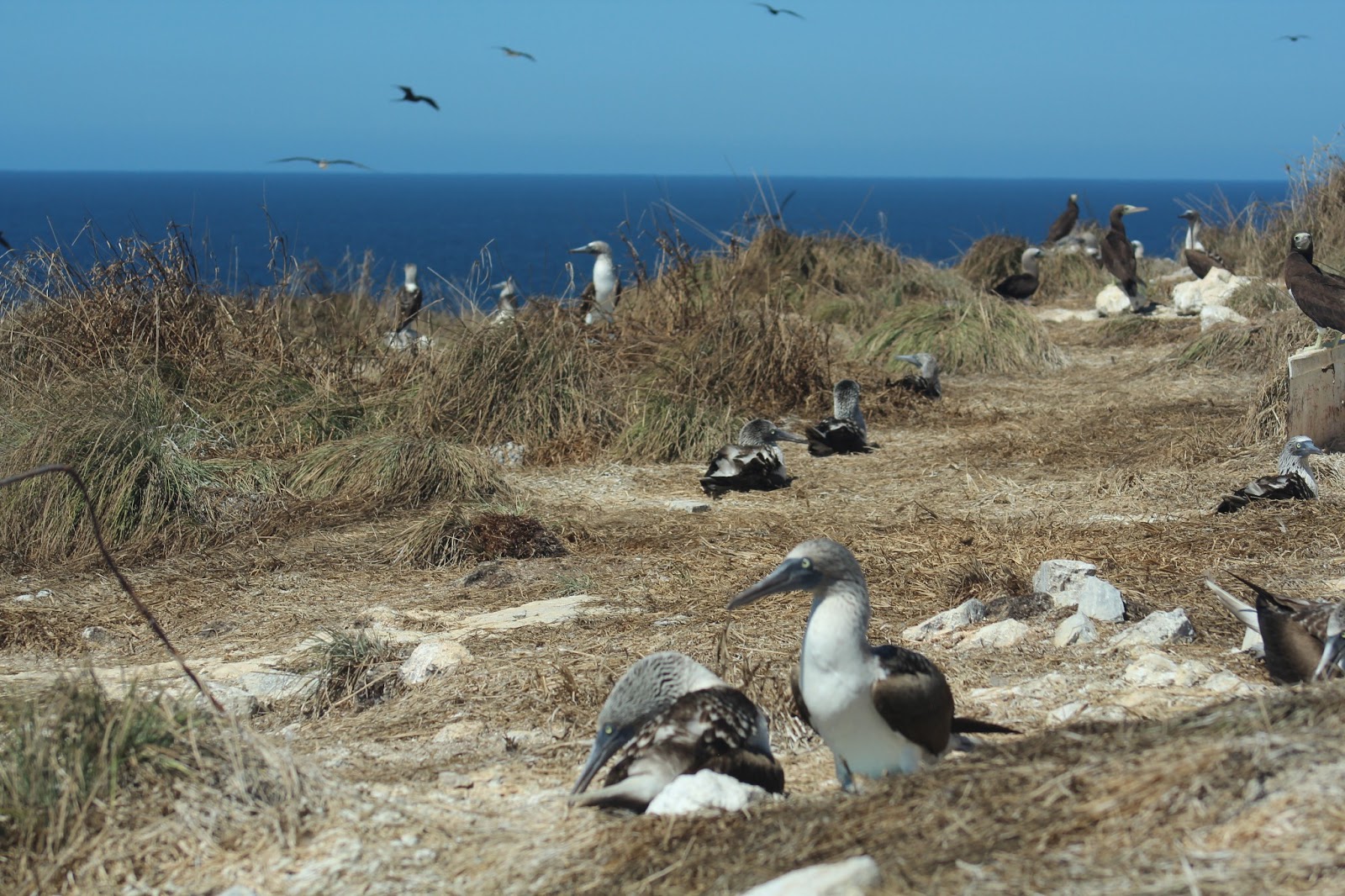
As we approached the island we were amazed to see 1000’s of birds
circling in the air above the rocks. After
we carefully put down our anchor (and trip line with float!) we started looking
around and were stunned to see that every rock and every tree on the island is literally
COVERED with birds! I thought we had
seen a lot of birds in other places, but it was nothing compared to this.
The boobie population is mostly concentrated in two areas –
the tall hill to the west (where the light tower is located) and near Las Monas
– the two towering rocks on the east side of the island. I am not exaggerating when I say that we saw
100’s of boobies! It was amazing – there
were nests every few feet in some areas – all with boobies of various types
guarding an egg. It was so much more
than either of us had expected – absolutely stunning. And since they are protected here, all of the
birds are not afraid of people – so you can get within feet of them. That said – if you do get within about 2-3
feet of the boobies they kind of bark/quack at you and it’s very clear that
they would like you to go away.
At one point we were standing at the top of the west hill
below the light tower, just kind of looking around and taking pictures. There were birds all over the tower and one
obviously REALLY wanted us to leave as it took very careful aim and let loose a
large amount of bird doo – and scored a DIRECT HIT! Yes, we were officially christened on the island. But it was totally worth it to get to see so
many nesting boobies of all kinds.
To top it off, there is also EXCELLENT snorkeling to be had
here. We explored the rocks in the southeast
portion of the anchorage (about 300 feet from where we anchored) and there were
1000’s of fish of all types and sizes – fantastic!
All in in, I would highly recommend a stop at this wonderful
place if you ever have the chance to go.
It was an incredible experience that was every bit worth the risk of
having to deal with a stuck anchor. Best
of all, our anchor pulled right out!
 |
| Blue-footed boobies |
 |
King Iguana
|
 |
| Fish Camp at Isabella |
Since we arrived at sunset, we had to wait until the next
day to go to shore. There is a small active
fishing camp here along with an abandoned research station that is sometimes
used as a camp for visiting researchers and eco tours. Other than that, the island remains fairly
untouched and is a huge showcase for the vast bird population. We landed the dinghy near the fish camp and
then basically explored about 80% of the island – which only took about 3 hours
as it’s not very big.
 |
| Lots of nesting boobies! |
 |
| A brown boobie with a new addition! |
 |
| Female Frigate |
 |
| Male Frigate Mating Display |
 |
Watch your step!
|
Saturday, February 16, 2013
Our Time in La Paz and the Sea of Cortez
 |
| Brett on the Malecon in La Paz |
We arrived in La Paz in November, just prior to
Thanksgiving. The weather at that time
was in the mid-80s and the winds were very light. Because of various visitors, we knew we would
be in the area until late January – which is a long time for us to stay in one
place, but we really looked forward to getting to know the area and the people there.
 |
| Beautiful and Interesting Hotel Yeneka |
La Paz is an amazing town – there are so many great
restaurants to eat in, you hardly know where to start. During our time there, we probably ate at
over 25 restaurants – varying from a small hole in the wall with 2-3 tables, to
one of the most expensive steak houses in town (Estancia Uruguaya - where we
had one of the best steaks I’ve ever eaten).
Out of all of those restaurants, I can’t think of one that we had a bad
meal at and we never got sick or had any issues of the classic “Mexican”
variety. And yes, we ate a LOT of
salads! In fact, the food in La Paz is
some of the best I’ve ever eaten – a wonderful mix of flavors and spices that
we will greatly miss once we leave.
 |
| Scuptures on the Malecon |
The people we met in La Paz are also incredibly friendly and
helpful – especially if you try to speak the language. I only know the basics – but any effort is
greatly appreciated and they are very patient and love to help you learn the
language. While there are many people
that can speak English (especially the younger people), I think it’s always
best to try – even if you are bumbling along.
Plus, if you don’t practice, how will you ever learn? But so many people speak English it’s easy to
forget to practice!
Getting around La Paz is also very easy. First off, there is an amazing “Malecon” that
runs along the water for miles through the city – great for walking with
wonderful sculptures about every block. There
are taxis everywhere, plus an excellent system of buses that you can take for
just 8 pesos per person around town.
With a little searching you can find pretty much any item you need in La
Paz. We put in countless miles walking
around town getting supplies and finding new places to eat or interesting
little stores. By simply wondering
around on foot, we found many special places that we would have definitely
missed in a car. That said, if you are
not into walking there are several car rental agencies and most of them will
even bring the car to you!

If you are a boater, there is a wonderful group of cruisers
that live in La Paz over the entire winter (many stay year-round) and they are
an invaluable resource if you need help finding a specific item or
service. There is a cruiser’s “Net” that
runs on VHF channel 22, Monday thru Saturday, with a different Net host each
day (my personal favorite was Gunther on Friday’s). The net includes announcements for arrivals
and departures, for local weather, the local tides, a section for local assistance
(where you can ask about anything you need), and a swaps and trades section if
you are looking to get rid of something out of your bilge. Remember that as a non-resident you are not
able to sell in Mexico – only to trade “for coconuts”! There is also a yacht club – Club Cruceros –
which hosts a morning coffee hour every day except Sunday. They also host special events over the course
of the year and help raise money for several local worthy causes. They have a huge DVD lending library that
members have access to and it’s only about $10 US to join.
 |
| Another Great Hike! |
About 2 hours north of La
Paz (assuming travel at an average of 6 knots) there are two large islands –
Espíritu Santo and Caleta Partida. There are many wonderful anchorages on these
two islands, all of which are well protected from the north – but almost all of
them are exposed to south winds. There
are wind events here called “Coromuels” where strong winds will blow from the
south from late afternoon to early the next morning. These happen more often in the summer, but
can still happen in the winter too. We
know, because we’ve been through several and they are not fun!
So now to the bad part
of being in La Paz during the winter – the part that nobody seems to mention in
any of the cruising guides and the reason we never got very far north into the
Sea, even though we were there for almost THREE MONTHS! December and January are fairly chilly and we
had almost constant “wind events” (i.e. sustained winds over 20 knots). We had multiple cases where we were stuck at
anchor for 3 days in sustained winds from 20-30 knots. When I say sustained, I mean sustained in the
high 20’s to low 30’s for 72 hours with gusts up to 40 knots in our “protected
anchorage”. It was not fun and it was cold! We also had some terrible experiences out at
the islands – one night of 35+ knots all night with 3-4 foot waves causing us
to hobby horse all night, another where we spent 3 days/nights in 30+ knots and
watched multiple boats dragging – all inside the most protected anchorage.
 |
| Ensenada Grande on a Calm day |
I can honestly say that
my top 4 worst nights at anchor now all took place in La Paz and the
surrounding area – and we’ve been anchoring out all over the Northwest for over
10 years! While La Paz is a great area,
I just wish someone had warned us that December and January were not good
months to be there. That said – when it
wasn’t blowing 30 knots the anchorages were absolutely beautiful, with
excellent snorkeling, kayaking, paddle boarding, swimming, incredible white
sandy beaches and fantastic hikes. The
wildlife is stunning and the fish are abundant.
So my basic advice would be to come – just don’t come for the months of
December or January. Enough said!
 |
| Addy & Cyntia - Marina de La Paz |
If you plan to bring
your boat to La Paz and you don’t have a big budget, there is a huge anchorage
area with room for 100’s of boats and the cruisers really look out for each
other. If you want to stay at a dock,
there are about 5 different options and prices vary depending on how many days
you stay. Our personal favorite is
Marina de La Paz. The girls (Addy &
Cyntia) are incredibly friendly and helpful – even when you are not staying at
their marina. You will find the daily
rate at all of the marinas is very expensive – over $100 for a 46’ boat. However the weekly rate at most of them will
drop substantially and the monthly rate is even better. Over the winter many of the marinas are full,
so it is wise to make arrangements prior to the fall if you want a long term
slip.
Charts! If you are going to cruise this area, you
absolutely MUST have the book by Shawn Breeding and Heather Bansmer called the Sea of Cortez, A Cruiser’s Guidebook. This book has excellent coverage of the
Sea with great illustrations of all of the anchorages. Most important – the illustrations show the
depths of the anchorages, which you WILL NOT get from any of the paper charts
OR electronic charts. Let me repeat –
none of the electronic charts (at least from Navionics) show anchorage
depths. They only show depths outside of
the anchorages – so this book is absolutely necessary for entering anchorages
safely.
 |
| View from the top at Ensenada Grande |
So! Knowing what we know now, would we still come
to this area? Without hesitation – we
loved La Paz! What would we do
differently? We would not go during
December or January when the weather is too unsettled to be comfortable at
anchor. I have high hopes however that
someday we will be able to return to the area during the “true” cruising season
(October, November, March or April). From
what we hear, it gets very hot after April and you are at some risk of
hurricane season, so plan accordingly!
We look forward to
seeing the friendly, wonderful people of La Paz again someday and thank them
all for making our stay there the best that it could be!
Subscribe to:
Posts (Atom)