Monday, July 15, 2013

The Big City


Rainbow over the Tahiti Yacht Club, Arue, Tahiti
Coming into Tahiti after cruising the Marquesas and the Tuamotos is a little like living in the smallest town in America and then moving to New York.  You’ve been exploring places that usually have one main street that’s about ½ a mile long with maybe one small store, a post office and a bank if you’re lucky.  If I had to guess, the average population in the Marquesas might have been around 2000 people per “town” and in the Tuamotos it’s more like 200!
Our friendly Tahitian bus driver.
Love the personal flair!
Tahiti on the other hand, is the center of French Polynesia – it’s their New York.  According to our guide book, “of the 230,000 inhabitants of French Polynesia, more than half (120,000) live in Papeete.”  Remember that French Polynesia includes all of the Marquesas, the Tuamotu’s, the Austral’s  and the Society Islands.  If you add up the entire area, it’s over 3.4 million (!!!) square miles worth of the earth.  That said, the actual LAND coverage of the 118 islands is just 2485 square miles – “a mere speck of dust scattered on the immense ocean”.  That’s a lot of water and not much land – kind of wild when you really think about it.

So landing in Tahiti (their New York) after several months in these tiny islands was almost like going into culture shock for us.  There is an international airport, a huge and VERY busy cargo Port, a large downtown with tall building (more than 2 floors!) and most importantly – REAL GROCERY STORES!!!!  

The wonderful downtown market - so much great stuff!
Since leaving Mexico we have been shopping in these tiny local stores, which are a little like shopping at a 7-11 on steroids.  A kind of catch-all store with the basics – lots junk food, cookies, pop, beer, plus maybe a few hardware items and maybe even a few t-shirts or sandals thrown in.  Vegetables were pretty scarce – maybe some potatoes and onions and if you were lucky you might find carrots and a cucumber or two.  If you REALLY hit the jackpot there might even be a head of cabbage and a couple of bananas.  It takes a little getting used to, but its fine once you get into the swing of things.  

How I felt when I couldn't
buy EVERYTHING!
But Tahiti, sweet Tahiti, has a Carrfour!  According to friends, this store originated in France – but (being under French rule) has been introduced very successfully in Tahiti – and I am VERY thankful for that!  For you Seattle readers it’s just like shopping at Fred Meyer – a HUGE grocery store with lots of Target-like stuff thrown in too.  Suddenly we have access to everything we haven’t seen in months!  Being a “foodie” it’s a little like giving a crack-head a big bag of drugs……and then saying “oh – don’t go through that too fast – you’re on a budget so use it wisely”!    

You would be amazed at the strength of the buying IMPULSE when it hasn’t been satisfied for a very long time – it’s very strong.  But being on a pretty tight budget we (wisely) decided that we should do a “walk-through” the first time and not let ourselves buy anything.   It was almost as satisfying just LOOKING at all the stuff we could buy.  After the walkthrough we went back to the boat and talked about what we really NEEDED and what we could actually AFFORD.  This makes for a much smaller list that is MUCH kinder on the budget.  It’s a little tough to keep your head in that sort of situation – we know cruisers that went in and spent over a $1000 – but I’m proud to admit we escaped for just over $300.  Not too shabby I think!  

Beautiful flower head garlands for sale
But enough about groceries!  What did we DO (other than shopping) while in Tahiti?  We caught up with old friends, we explored the island and we did some minor repairs.  We actually stayed much longer than we thought we would.  Everyone had told us what a “pit” Papeete is but I couldn’t disagree more.  Is it crowded, loud and dirty (like every big city)?  Absolutely!  But there was something kind of wonderful about being in that atmosphere again.  Just walking around all the stores and businesses and seeing all the commerce was a little refreshing after months of “island life” and the slow pace that goes with it.  There’s something quite inspiring about seeing Capitalism alive and well in the 3rd world.  

Sunset over Moorea

 While in Tahiti we enjoyed two beautiful anchorages – the first in the town of Arue, just east of downtown and the home of the Tahiti Yacht Club.  Being Seattle Yacht Club members, we introduced ourselves to the manager and gifted him an SYC burgee.  He was beyond excited and promptly allowed us full access to all of their facilities, which he normally can’t allow cruisers to use as it would be too big a burden on the small club.  We were delighted with the club and happy to see a very good youth sailing program at work.  Our second stop was the rather huge anchorage/marina area just northwest of the main Papeete Port.  This is where the majority of cruisers stay to provision, buy parts and fix everything they can before moving on.  We ran into MANY boats we have met along the way here and it was great fun to catch up and spend time with friends we hadn’t seen for a while.  I’m happy to report that both anchorages were really beautiful – situated just behind the protective reef with amazing views of the ocean and the island of Moorea in the distance.  We had breathtaking sunsets almost every night – what’s not to like about that?

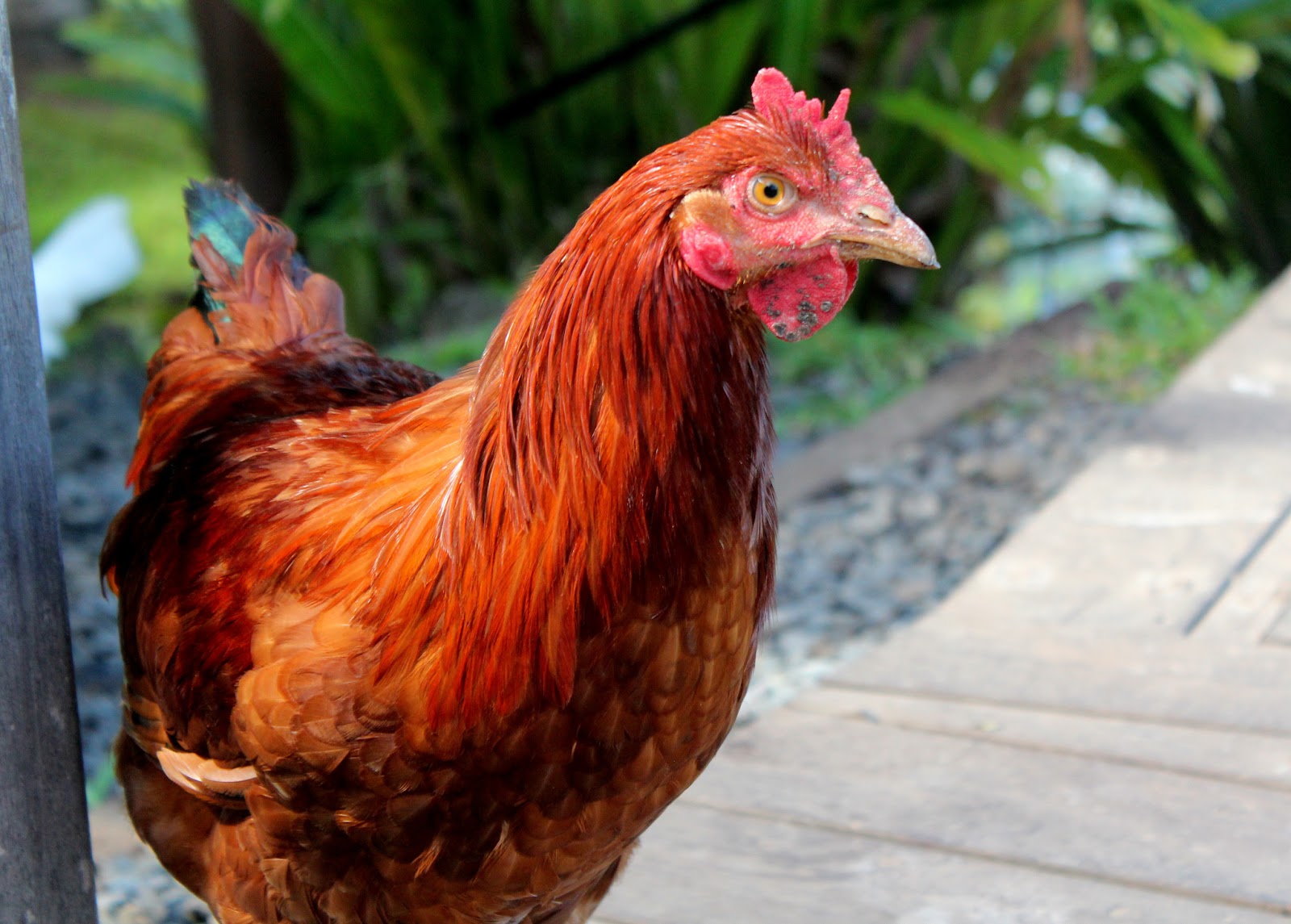
Does this rooster look annoyed or what?  Kind of how we
felt after paying $90 for a couple of spot welds...
In this part of the world, Tahiti is basically your best (only??) chance for finding professionals that work on boats and most parts can also be located or ordered and flown in – so LOTS of boats get work done here before moving on.   If you can’t fix it here, your next best hope is New Zealand, which is 1000’s of miles away, so you really hope you can fix it here.  We had our own list of repairs – thankfully fairly small compared to some boats we know.  What repairs?  Mainly our refrigeration system had two issues – it needed to be recharged with more Freon, plus we had snapped the bracket on our engine driven side – so had to have that re-welded.  While I’m delighted to say we were able to find a welder, we were not so happy to pay the $90 he wanted for 3 spot welds – which probably took him about 2 minutes to do.  But when you need something done – you just have to buck up and pay.  Thankfully the Freon recharge was only $50 – so since we were expecting that to be more it helped offset the pain of the welded piece.  

Dinner on Cassiopée - can you tell it's the end of the night?
While here we spent a lot of time with friends, including an AMAZING dinner with Claudine and Gérard onboard Cassiopée – who insisted we have a “true French meal” with all the courses (5!) and the appropriate accompanying beverages.  I now understand why the French are so proud as it was easily one of the best meals we’ve had in a very long time.  They also invited us to join them for a tour around the island in their rental car – a much easier way to see the island than sailing around the whole thing.  It was great to take in all the “sites” that we would have missed without a car – thanks again guys!

Local boat storage!
All in all, we thought Tahiti was great – just the right mix of big city and incredible tropical beauty.  It may be the “New York” of French Polynesia, but we thoroughly enjoyed the “bright lights and big city” atmosphere for the two weeks we were there.


Very old stone tikis at the religious site of Marae Arahurahu

Tuesday, June 25, 2013

Last Stop in the Tuamotos, Apataki


Surf at Pakaka Pass, Apataki

After leaving Fakarava, we had a great sail over to the atoll called Toau, stopping overnight at the small inlet known as Amse Amyot.  There is no pass to get into this spot as it’s more a closed basin in the reef where an enterprising family has provided some mooring balls and will make dinner for cruisers if there are enough to make it worthwhile.  We got there just as the sun was setting and so had to pick a spot pretty quickly.  The wind had been in the 20’s all day, so there was a lot of water coming out of the lagoon – making it seem like we were in the middle of a raging river.  The family was motioning for us to pick up one of their mooring balls – which in the middle of a 4-5 knot current can be pretty challenging, but I’m happy to report the captain made it seem easy.  Trusting that unknown mooring ball overnight in the 4-5 knot current with winds still in the 20-30 knot range – not so easy!  I can tell you that I did not exactly experience a good night’s sleep, but thankfully it did hold and all was well in the morning.  Knowing the conditions were unlikely to change for the next two days, we decided not to push our luck and so left for Apataki.  

The town at Apataki
With winds in the 17-20 knot range and a 7 foot swell, we had a nice downwind trip to the south pass called Pakaka Pass.  The atoll of Apataki is about 18 miles (north to south) by 15 miles and we hadn’t heard much about it – except for the fact that the south pass can be pretty tough if the winds have been high (which they had).  After careful consultation on when slack tide would occur (and you know how successful we’ve been with that if you’ve read my last post!), we approached the south pass.  Seeing a local paddle out of the pass in his outrigger canoe, we decided to go for it.  Even though the surf was running pretty high, it looked passable.

Passing port to port...
Pakaka pass is actually a two part pass as there is the main outer reef, followed by an open area where the town is, and then there is another pass through a narrow reef which will actually take you into the lagoon.  We got through the outer reef with no issues – unless you count our hearts stopping when we discovered that the local supply ship had decided to exit the pass right as we were entering.  After a brief radio discussion, we passed port to port and thankfully had enough room – but it still made the heart go pitter patter!  


It felt like we went as slow as this hermit crab!
While the “town” area looked pretty nice, we had our sights set on the south end of the lagoon, which would be more protected in the high winds.  Unfortunately, we would have to get through the inner pass to get there.  The book we have reads as follows, “On the lagoon side of the pass it bends toward the south, with a coral bank of 6 to 7 meters provoking an acceleration of outflowing current.”  As we approached, doing our standard 2000 RPM’s on the engine, we started to experience the….um……”accelerated outflow “, especially pronounced by the excess of water in the lagoon due to the recent high winds.   About half way through we really started to lose momentum – five knots…..four knots……….3 knots……..2  knots…….”Um – honey, I think we need to bump up our RPM’s!”, but Brett was already there, pushing up to about 2800 RMP’s.  Unfortunately it’s not enough……1 knot…..1/2 a knot…..it’s not looking good.  Did I mention how wide it is here?  About 40 feet…..and the current is slowly pushing us sideways towards the reef.  There are no pictures of this part because we are fully focused on just trying to get through.  We bump it up to 3200 RPM’s and are now barely making about ½ a knot against the current.  After about 10 minutes of excruciatingly slow progress, we finally begin to pick up speed and make it through without hitting anything.  Phew!!!  

Our little slice of heaven!
I’m happy to report the inner lagoon was worth every minute.  Since Apataki is a little “off the beaten path”, we saw very few other boats and it was absolutely breathtaking!  After a short sail, dodging various pearl farm buoys, we found a little slice of heaven in the south end, behind a motu called Rua Vahine.  We stayed here for four days and even thought the wind was howling almost the whole time, the spot was well protected and we hardly felt any swell.  When we first arrived there was a catamaran a ways off with some hard core kite boarders that were out in that wind almost non-stop.  You wouldn’t believe the air they were getting – check out the photo.  Amazing!   

Look at the height this
kite boarder is getting - wow!
After some great beachcombing and a few restful days at anchor, we decided to move up to the southeast corner where the only boat yard in the Tuamotos is located.  There is something really strange about seeing a bunch of masts peeking out of the palm trees, but this yard is well run by Assam and his family – who also happen to sell some of the best eggs I’ve bought yet!  As we were hunting around for a good spot to anchor (trying to avoid the MANY coral heads in the area), Assam’s son came out and quickly led us to one of their free mooring balls – which we later dove and found to be well placed and very strong.  The whole family was incredibly nice and eager to help us with anything we needed.  We stayed here for two days and had some great snorkeling around the end of the motu Omira.  What a beautiful spot!  

Our snorkeling buddy...
Leaving Assam and family behind we traveled up to the NE corner of Apataki – where there was not a soul to be seen for miles.  We found a lovely little spot to stay the night and enjoyed a spectacular sunset over the lagoon.  Unfortunately it was time to prepare the boat for the trip to Tahiti as high winds were again being predicted and we fervently wanted to avoid a repeat of our passage to the Tuamotos.  So we decided to leave while the winds were lighter and ended up having a really lovely passage to the Society Islands – what a nice change!

Sunset in the north end of Apataki
We were sorry to say goodbye to the Tuamotos – they are unbelievably beautiful and if we had one piece of advice for future cruisers, it would be to spend less time in the Marquesas and MORE time in this area.  It’s relatively untouched, the people are very kind and not nearly as affected by the tourism, so it just felt like a more “real” experience rather than one tailored to meet certain expectations.  While it was a little windy and the passes can be challenging, the landscapes are everything you ever dreamt of – absolute perfection.  This was our favorite spot (by a long shot) in our travels thus far…

Goodbye Tuamotos!

Sunday, June 16, 2013

Fakarava, Tuamotos


Leaving Kauehi was not easy as it was by far one of the most beautiful places we have ever been.  But leave we must as we are only allowed 90 days to explore the entirety of French Polynesia and the clock was ticking.  So with tide tables in hand, off we went to the popular atoll of Fakarava. 

Starting into the pass, note the
calm water on the other side!
Fakarava is one of the largest atolls in the entire Tuamotos and has two entrances into the lagoon – the north pass and the south pass.  Being fairly new at traveling these passes (and having heard of a few harrowing experiences from cruising friends) we opted for the larger and downwind option, the north pass.  Arriving at what we thought was slack tide (based on two different sources) we took a look and decided it seemed…um….passable, so started to make our way through.  

At first, things seemed fine – we only had about 1 knot of current against us, so not too bad.  As we got farther in however, the current against us began to climb and soon we were fighting a 3.5 knot current!  Yes – 3.5 minus what was currently our 5 knot boat speed (due to a little furry growth on the bottom) now meant that we were only moving forward at 1.5 knots.  I CAN WALK FASTER THAN THAT!

The view from within the pass - not as nice!
Needless to say, we did make it through without any mishaps, but now having a total distrust of all sources of tidal information, we just try to watch the ups and downs over the course of each day and do some estimating on our own.  With our EYES!  Of course, that will only get you so far since if the winds are high (which happens OFTEN) extra water is likely filling the lagoon, potentially creating a continually out-flowing current in the pass – so then who knows when it might be slack (um…never?).  Have I mentioned how frustrating this tide/pass conundrum is here?  It is a FAVORITE topic among cruisers.

But enough of tides and passes!  Let’s move on to the fascinating process of pearl farming.  Many of the atolls in the Tuamotos are renowned for their pearls – just like the ones women everywhere wore in the 50s, only these are dark grey instead of pearly white.  They are quite beautiful, so we wanted to visit a farm and hopefully purchase a few quality samples at a good price.  

Through our friends on Cassiopée (thanks AGAIN guys!) we soon had a reservation to visit the Hinano Pearl Farm (ironically the same name of the only beer you’ll find in this area).  What a great experience!    We were thoroughly educated on the process of pearl formation.  For someone like me who had zero idea of what it takes to cultivate a black pearl, I was amazed at the long and fairly complex process that needs to be followed before one single pearl is created.  Now I understand why they are so expensive!

Where the pearl surgery is performed...
One might THINK that you simply find a qualified oyster and throw it out in the salt water for a couple of months (years?) hoping for the best – but of course it much more complex than that.  First the “farm” will purchase oyster shells of a certain quality, taking particular note of the colors of the inside of the shell – which will often determine the color of the pearl the oyster will create. 
Next, they place a precisely formed “fake” pearl – usually a bead made of shell and approximately 3 millimeters in diameter – in a small pouch within the oyster.  This is a very important step as they must take out what was already growing within the oyster and carefully replace it with the perfectly round replica without doing any harm.  The goal here is to implant the fake without the oyster realizing anything has changed.  If it does, it’s highly likely the oyster will reject the surrogate and stop producing altogether – which of course they won’t discover until many months have passed.  So it’s rather a fine surgery of sorts, all done without opening the oyster more than about ½ an inch!  

After they have successfully implanted the “fake” pearl the oysters are “put out to pasture” (if you will) in just the right depth and sea conditions for 6 months to start cultivating the lovely dark grey layers that make these fakes into the real beauties they become.  After 6 months the oysters are collected and carefully opened to see if the process was successful.  If it was, the new pearl (consisting of the original fake now covered with many layers of “real” pearl growth) is removed from the oyster (using that same careful technique) and a new “fake” of the exact same size is inserted in its place.  

Our guide showing where the growth pocket is.
WHAT???  You mean you don’t just leave it in there to get bigger and more beautiful with each passing month?!?  Apparently not!  We learned that a pearl left for a long time hardly EVER turns into the big beautiful pearl some lucky duck just “discovers” in the movies.  In real life that pearl would be lumpy and misshapen – plus the layers would not be as strong and so the pearl could be easily broken – making the customer who paid big bucks for it VERY upset!   Because of this, it’s highly important to regularly introduce a new, perfectly round fake for the oyster to keep covering up.    Sounds strangely similar to our government….but I digress.

So!  This is how they get different sizes of pearls – by replacing the newly grown pearl every 6-12 months with a new like-sized fake.  Then the new (larger) fake is covered with beautiful layers until its a few millimeters larger yet….and so on and so forth.  It turns out those really large black pearls that are so incredible valuable if they are perfectly round and without blemishes cost that much because they can take up to 6 YEARS TO GROW!!!  Yep – that’s some serious time invested!  These are obviously very patient people.

"A" grade pearls on display.
Just like diamonds, black pearls are graded by size, shape and blemishes (or rather a lack thereof).  Top grade is an “A” and just like school – the lower you go the less quality you get.  “B” pearls are still of very nice quality and to the untrained eye a “C” quality pearl might also be acceptable.  But after that things start to go downhill pretty quickly.  We actually liked some of the “lower quality”, misshaped pearls as they were often pretty interesting to look at.  These pearls are often relegated to a quick leather necklace or bracelet for not very much money (now owned and proudly worn by yours truly).  While I love my “imperfect” cheap pearl, we also decided to purchase a couple nicer samples as this chance is unlikely to ever present itself again, especially at these prices.  Overall, our visit to the pearl farm was a fascinating and educational experience. 

One of the best (non-environmental) aspects of French Polynesia is the access to quality baked goods – which one soon becomes addicted to.  Prior to leaving North Fakarava, we made an early morning run to get a few (much sought after) baguettes at the local bakery/market.  This is one of those cases where the early bird will get the worm and the late bird will get……..nothing!  The residents here, being governed by the French, have developed a fine affinity for perfectly baked baguettes (crunchy on the outside but soft and airy on the inside) and they are baked fresh every day.  When they are gone, they are gone for the day – so get them while you can as they are a real treat and one of the few items in French Polynesia that do not cost an arm and a leg.  If you are REALLY lucky, you might also find chocolate croissants (pan chocolate) that are absolutely delicious!

The moon mid atoll - beautiful!
Baguettes on board, off we went to the south end of Fakarava.  Fakarava is approximately 30 miles long (north to south) and 10 miles wide – so it can take a while to make it to the opposite end.  There are many lovely (non-charted) spots to stop along the way – so you don’t have to travel the whole way if you get a late start.  We chose to stop half way down in an uncharted spot for a night and had the place completely to ourselves – which is much rarer than you might think.  After moving to the SE corner – called Hirifa – for a few days, we proceeded over to the popular anchorage on the west side of the south pass.  

The south pass of Fakarava is almost legendary in diving circles, with folks arriving from all over the world to pay for a chance to dive these shark infested waters.  How cool is it that we were able to drift snorkel them for FREE!  Yes, yours truly, proud member of the JAWS generation, actually got knowingly in the water with SHARKS!  Thankfully most of the sharks here are of the black or grey tip variety, which are only about 3-4 feet long and not very interested in humans.  The ones that swam near me did take an inquisitive look, but when I showed them my menacing fist (HA!) they quickly darted away.  Take that long anticipated fears!!!  Of course if you dive here you actually get down to a level where you would be surrounded by 100’s of sharks – some that are fairly large.  Definitely not something this girl was ready for, so we just stuck to the drift snorkel – thank you very much.  

And what an amazing experience it was!!!  Basically you take your dinghy over to the beginning of the south pass just after the turn of the outgoing tide.  We’ve learned that you want to give it maybe 20 minutes after the turn as the clear water from the outside of the lagoon translates to much better visibility in the water.  Than you tie the dingy to you and let the incoming tide carry you (and your dinghy) past a wonderland of exotic and beautifully colored fish – FANTASTIC!  

South Fakarava after one of the frequent squalls.
We did the drift twice as there was so many fish to see, from tiny little clown fish to huge brightly colored parrotfish, that you just couldn’t see everything in one pass.  The drift takes about 20 minutes and the farther in the faster you go.  At one point I actually tried to slow my progress by swimming against the tide but soon discovered it was completely hopeless.   You just have to let the water carry you along and see what you can as you go.  Next item on the Christmas wish list????  An underwater camera!   I was dying to post some pictures of all the amazing fish we saw, but alas – no ability to shoot underwater at this time.  Sorry folks!  

Other than the snorkeling there is not a lot to do in south Fakarava other than enjoy the beauty of the area, so that’s what we did.......for 5 heavenly days!  We did accomplish several boating projects (which never end), such as repairing a tear in the mainsail and a major cleaning of the bottom of the boat – but we also got in a fair amount of relaxing and enjoying our surroundings.  South Fakarava is a little slice of heaven and we were happy to spend a good amount of time there.

Stay tuned for our further adventures in the Tuamotos when we travel to the river that is Anse Amyot and explore the wonders of Apataki…